
Example of the paper structure
Title Page
Please make sure your title page contains the following information.
Title
The title should be concise and informative. The title should express the essence of the paper. By reading the title, the reader gets an idea of the research topic and research problem. The title summarizes the subject of the professional and scientific research that the author approaches. A colon (:) is often used in the title to emphasize the research area. The title should be clear, indicative, current, neither too long nor too short. If the title is too long, split it into a title and a subtitle. The subtitle then specifies the research subject.
Abstract
Please provide an Abstract of 150 to 250 words. Do not include undefined abbreviations or unspecified references. The summary is divided into sections, but must be shown as a single block of text in the submitted paper. Start with a tweetable headline under 250 characters, including spaces. This headline should share the main result and spark interest. Then, write a simple summary of your study and its main conclusions. Although the abstract appears first, write it after drafting the full manuscript. The abstract gives a brief overview of the entire paper. Include one or two sentences on the purpose and importance, a sentence about your methods, and several sentences on key findings. Finish with one or two sentences on the impact of your findings on research, education, practice, policy, or society/environment. Make your abstract interesting to encourage readers to continue. Write the abstract in italics.
Keywords
Please provide 4 to 6 keywords which can be used for indexing purposes.
Classification code
JEL
An appropriate number of JEL codes should be provided. This classification system is prepared and published by the Journal of Economic Literature, see
https://www.aeaweb.org/econlit/jelCodes.php?view=jel
1. Introduction
2. Literature review and hypotheses development
2.1. Subheading
2.2. Subheading
2.3. Subheading
3. Empirical analysis
3.1. Sample
3.2. Variables
3.3. Dependent variables
3.4. Independent variables
3.5. Moderating variable
3.6. Control variable
4. Methodology
5. Empirical results and discussion
6. Conclusions and implications
6.1. Theoretical contributions
6.2. Policy and managerial implications
6.3. Limitations and suggestions for future research
Author Contributions (example): Conceptualization, J. R. and S. P.; methodology, J. R. and D. R.; software, J. R. and D. R.; validation, J. R., S. P. and D.R.; formal analysis, J.R., S. P. and D. R.; investigation, J. R., S. P., and D.R.; resources, J. R.; data curation, J. R.; writing—original draft preparation, J. R., S. P. and D.R; writing—review and editing, J.R., S.P. and D.R.; visualization, J.R., S.P. and D.R.; supervision, S. P. and D. R. All authors have read and agreed to the published version of the manuscript.
Funding (example): This research received no external funding.
This research was funded by USE IPM—HORIZON-WIDERA-2022-TALENTS-03-01 project, funded by the European Union.
Institutional Review Board Statement: Not applicable.
(Example) This research is part of the 101120390—USE IPM—HORIZON-WIDERA-2022-TALENTS-03-01 project, funded by the European Union. The views and opinions expressed are, however, those of the authors only and do not necessarily reflect those of the European Union or the European Research Executive Agency. Neither the European Union nor the European Research Executive Agency can be held responsible for them. Informed consent was obtained from all subjects involved in the study. Ethical review and approval were waived for this study, as they were not required under national regulations. The research was conducted in compliance with the ethical standards for social science research, the principles of the Declaration of Helsinki, and the Horizon USE IPM project ethical guidelines.
Informed Consent Statement: Not applicable.
(Example) Informed consent was obtained from all subjects involved in the study. All participants in the Delphi study and the needs analysis survey signed consent forms prior to their involvement and agreed to the use of their responses for research purposes.
Data Availability Statement: The data that has been used is available upon request to the author.
Conflicts of Interest: The authors declare no conflict of interest.
References
Appendix
Text Formatting
Manuscripts should be submitted in Word.
- Use a normal, plain font (e.g., 12-point Times Roman) for text.
- Use italics for emphasis.
- Use the automatic page numbering function to number the pages.
- Do not use field functions.
- Use tab stops or other commands for indents, not the space bar.
- Use the table function, not spreadsheets, to make tables.
- Use the equation editor or MathType for equations.
- Save your file in docx format (Word 2007 or higher) or doc format (older Word versions).
Headings
Headings and subheadings provide structure to a document. They signal what each section
is about and allow for easy navigation of the document. APA headings have five possible levels. Each heading level is formatted differently.
Table 1
APA 7th heading and subheading format
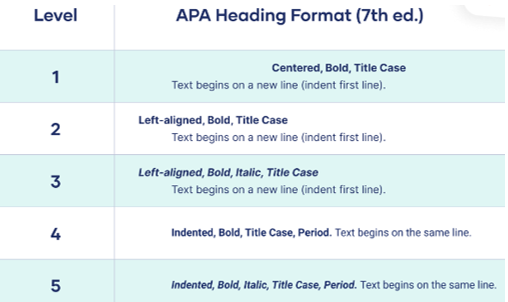
Note. Retrieved and adapted from https://www.scribbr.com/apa-style/tables-and-figures.
Abbreviations
Abbreviations should be defined at first mention and used consistently thereafter.
Footnotes
- Use footnotes to provide extra information, such as citations in the reference list. Do not use footnotes solely for reference citations, bibliographic details, figures, or tables.
- Number footnotes in the text consecutively. Indicate table footnotes with superscript lowercase letters or asterisks for significance and statistical data. Do not use reference symbols for footnotes to the title or authors.
- Always use footnotes, not endnotes.